

Choose industrial automation software by ISA-95 standards, not brand hype—avoid the 60-70% failure rate with our proven selection framework.
Industrial Automation Software: How to Choose the Right Platform

You've identified that manual production workflows cost your facility 10–30% in lost throughput and quality variance — productivity gains in that range are what McKinsey & Company and the World Economic Forum's Lighthouse program document for well-scoped automation projects. You've allocated budget. But the decision in front of you isn't "should we automate" — it's which industrial automation software architecture matches your production model. Pick wrong and you join the 60–70% of digital transformation programs that fail to meet original objectives, a failure band documented across McKinsey and Boston Consulting Group research.
The platform decision is where most programs quietly compromise themselves. Buyers shortlist by vendor brand, evaluate on demo dazzle, and discover six months later that the architecture cannot serve their production model at the latency and integration depth their plant requires. This article gives you the technical and financial filters to avoid that outcome.
Table of Contents
- What Industrial Automation Software Actually Controls
- Four Platform Categories Mapped to Production Models
- Five Capability Filters That Separate Production-Grade Platforms
- 5-Year Total Cost of Ownership: The Real Math
- The 16-Week Pilot Protocol
- Six Implementation Failure Patterns
- The Pre-RFP Readiness Audit
What Industrial Automation Software Actually Controls
The phrase industrial automation software is a catch-all that buyers conflate. RFPs ask one platform to cover physical control, production scheduling, regulatory documentation, and financial reconciliation — then blame the vendor when the architecture cannot serve all four. The fix is scope discipline at the standards layer.
The reference model is ISA-95 / IEC 62264, the International Society of Automation and International Electrotechnical Commission framework that defines the functional hierarchy of a manufacturing enterprise. Four levels matter for platform selection:
- Level 0–1 — the physical process, sensors, actuators
- Level 2 — monitoring and control: SCADA, DCS, PLCs, operating in the millisecond response band
- Level 3 — MES / Manufacturing Operations Management: production scheduling, genealogy, OEE tracking, work order execution
- Level 4 — ERP: financials, customer orders, materials planning
Each level has a different latency tolerance, a different user, and a different rate of change. A platform that excels at Level 3 reporting is almost never the right choice for Level 2 deterministic control, and vice versa. When you treat the layers as interchangeable, you get budget creep.
The Three Categories Buyers Confuse
Inside the "industrial automation software" umbrella, three software categories are doing very different jobs:
- Supervisory layer software — SCADA, HMI dashboards, and historians. These visualize plant state, log alarms, and feed analytics. They are not control systems; they observe control systems.
- Execution layer software — code running on PLCs and PACs, written in the five IEC 61131-3 languages: Ladder Diagram, Function Block Diagram, Structured Text, Instruction List, and Sequential Function Chart. This is where deterministic control loops live, typically in the 1–50 millisecond range. The AutomationDirect programmable controller overview is a useful primer on what these languages actually do on the shop floor.
- Integration and MES middleware — connectors and orchestration layers tying Level 3 production data to ERP, quality, and maintenance systems.
A vendor pitching a single "unified" stack across all three categories is making an architectural claim that deserves scrutiny, not applause.
The Penetration Reality
The market is less mature than vendor marketing suggests. Global surveys from LNS Research and ARC Advisory Group indicate that only 20–30% of plants run a fully deployed MES across all sites. Another 30–40% run partial or legacy systems. The remainder coordinate production through spreadsheets and tribal knowledge. If you are buying your first MES, you are not behind a wave — you are in the modal cohort.
The Misconception Worth Killing
Automation software does not replace skilled labor wholesale. Dr. Thomas Kurfess, Chief Manufacturing Officer at Oak Ridge National Laboratory, has argued that plants combining automation with workforce upskilling see the largest productivity and quality gains — significantly more than headcount-reduction-only initiatives. The platforms that deliver the documented 10–30% productivity gains do so because operators use them daily, not because operators were removed.
Scope clarity at the ISA-95 layer is the single highest-leverage decision in the program. Buyers who treat Level 3 software as a Level 2 control substitute consistently overspend by six figures and blame the platform. Buyers who scope to the right level, then commission intelligent automation solutions designed for that level, hit the productivity ranges the literature predicts.
Four Platform Categories Mapped to Production Models
Industrial automation software does not come in one shape. Four architectural patterns dominate the market, and each one fits a specific production model. Force-fitting the wrong category to your plant is the most common — and most expensive — early decision error.
| Platform Category | Production Model Fit | Pilot Timeline | Full Rollout | Control Latency Tier |
|---|---|---|---|---|
| Discrete Manufacturing Platforms | Automotive, electronics, machinery | 8–16 weeks | 6–12 months | Edge PLC sub-50ms; cloud for analytics |
| Process Industry Platforms (DCS + Batch) | Pharma, chemicals, food & beverage | 12–20 weeks | 12–24 months (validation) | On-prem DCS ms-level; ISA-88 batch layer |
| Hybrid / Universal Automation | Mixed production, frequent SKU changes | 8–12 weeks | 6–10 months | Edge + cloud split |
| Legacy System Wrappers | Brownfield, capital-constrained | 8–16 weeks | 9–14 months | Inherits legacy latency |
The discrete-versus-process split is the foundational distinction. Discrete manufacturers — automotive assembly, electronics, machinery, consumer goods — favor modular MES platforms that integrate with PLCs and robotics cells. The portfolio framing from Rockwell Automation and analysis in the Economic Times CIO feature on industrial automation systems reflects this: discrete buyers want module-based platforms they can configure per line.
Process industries operate differently. Pharma, specialty chemicals, and food & beverage rely on DCS with ISA-88 batch control and FDA 21 CFR Part 11 compliance modules baked in. The validation overhead is real — regulated process pilots run 12–24 months, against 8–16 weeks for discrete, per Deloitte pharma digital plant case studies and ISPE implementation reports.
Process plants resist cloud-only architectures for one technical reason: safety-critical interlocks need control loop latency in the 1–50ms range that cannot tolerate cloud roundtrips. According to AutomationDirect's control system overview and Rockwell's architecture guidance, this is non-negotiable for equipment protection and high-speed motion.
The "universal automation" category is growing because vendors like ICONICS and Schneider Electric unify HMI/SCADA, analytics, and IIoT connectivity into a single stack — the vendor argument being reduced integration overhead in mixed environments. That argument has merit for plants with frequent SKU changes and heterogeneous lines. Treat it as a vendor narrative until you have independent benchmarks for your specific production mix.
Legacy wrappers tempt risk-averse buyers because they preserve sunk capital. The trade-off is documented by ARC Advisory Group: proprietary protocols and engineering tools create vendor lock-in that conflicts with the open modular architectures most CIOs say they want. Wrappers buy you 18 months of stability and a much harder migration in year three.
The decision rule: weight technical fit at roughly 60% and vendor stability at roughly 40%. The inverse weighting is how market-leading platforms end up in plants where they cannot perform.
The most expensive platform failure is not a technical crash. It is a mismatch between architecture and production model. A two-hundred-thousand-dollar platform chosen for the wrong manufacturing type becomes a five-hundred-thousand-dollar problem inside eighteen months.
Five Capability Filters That Separate Production-Grade Platforms
Once you've scoped to the right platform category, the next filter is capability depth. Demo-grade platforms look identical to production-grade platforms in a slide deck. Five technical filters distinguish them under load.
1. Sub-50ms Edge Control + Sub-Second Supervisory Visibility
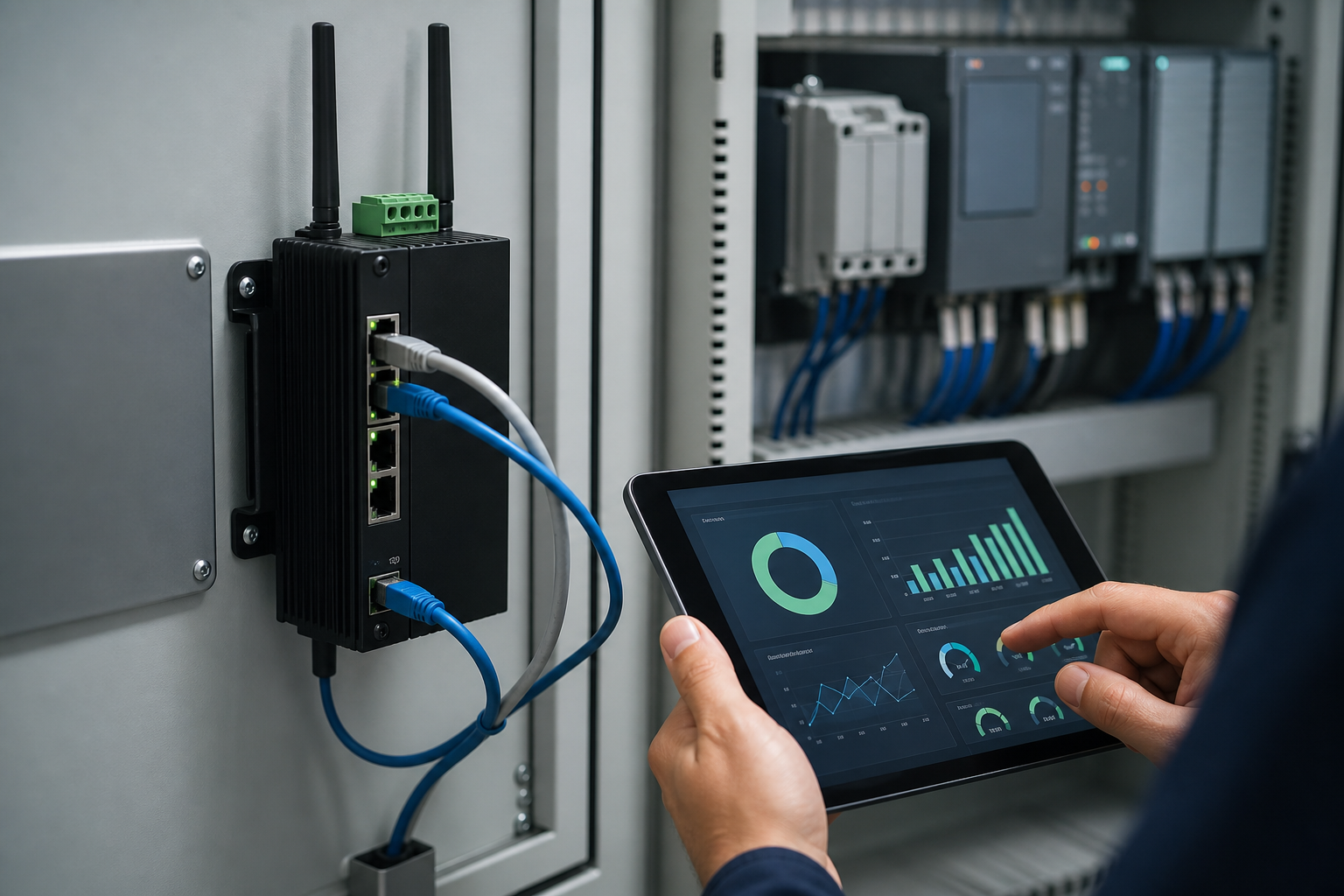
The architecture has to honor the latency tiers. Local PLC/PAC must handle deterministic control loops at 1–50ms. Supervisory dashboards refresh at seconds-to-minutes — that is appropriate for visualization, not for equipment protection. AutomationDirect and Rockwell both document this split clearly in their control architecture materials.
The red flag is vendors marketing "real-time" capabilities with 5+ minute polling intervals. Independent reviewers and the architectural positioning from ICONICS itself confirm that cloud polling at multi-minute cadence is supervisory, not real-time. Edge computing handles equipment protection. Cloud handles analytics. Never the inverse, regardless of how the marketing reads.
2. Predictive Maintenance with Trainable Models
The capability you want: vibration, thermal, acoustic, and electrical sensor integration feeding ML models that retrain on your equipment history, not pre-baked generic models trained on someone else's pumps.
The documented value range is meaningful. McKinsey Global Institute and Deloitte case studies on predictive maintenance report 30–50% reduction in unplanned downtime, 10–40% cuts in maintenance costs, and 20–40% asset life extension when programs combine analytics with appropriate process changes and operator training.
Dr. Jay Lee, founding director of the NSF I/UCRC Intelligent Maintenance Systems Center, frames the value correctly: the gain comes from transforming maintenance into a data-driven function, not from deploying algorithms in isolation. A platform that ships "AI-powered" claims without explainability or customer-data training capability is not delivering genuine AI capability — it is delivering a marketing badge. Push for the ability to retrain on your data, see the features, and adjust thresholds.
3. ISA-95-Aligned Integration with ERP, MRP, and Quality Systems
Look for pre-built connectors for SAP, Oracle, NetSuite; API-first architecture; OPC-UA and MQTT support; and a clean separation of Level 3 (MES) from Level 4 (ERP) functions per ISA-95.
This is the filter that consumes the most project budget. Integration regularly accounts for 30–40% of total implementation effort per Gartner and LNS Research, and is the technical layer where the majority of failed digital programs collapse, per McKinsey's transformation outcome research.
The red flag is "we'll custom-build the connector" presented as a feature rather than the last-resort fallback. Custom connectors are six-month risks pretending to be six-week deliverables. Buy native connectors for your top two integration targets or do not buy the platform.
4. Native Compliance for FDA 21 CFR Part 11 and IEC 62443 Cybersecurity
For regulated industries, the platform must ship with built-in electronic signatures, tamper-evident audit trails, timestamped logs, and role-based access — the FDA 21 CFR Part 11 requirements for electronic records.
For every plant — regulated or not — the IEC 62443 framework defines secure development practices, network segmentation, authentication, and patch management for industrial control systems. NIST SP 800-82 warns that increased connectivity expands the OT attack surface. Poorly segmented networks have caused ransomware-driven production stoppages across multiple ICS-CERT advisories.
The red flag is compliance described as "achievable through configuration." Retrofitting compliance costs three to five times more than native support, and the gap reveals itself during the audit, not during the demo. Treat cybersecurity as a hard filter at RFP stage, not a phase-two add-on.
5. ISO 22400 KPI Standardization and Multi-Site Templating
Native OEE calculation per ISO 22400 — availability × performance × quality — plus standardized templates for multi-site rollout and master data governance.
World-class OEE benchmarks sit at 85% or higher. Automation justifies itself by lifting OEE 5–15 percentage points through reduced downtime and scrap, per ISO 22400 and TPM/JIPM literature. Without standardized KPI definitions, pilots do not scale. Each new site needs custom configuration, master data conflicts, and re-validation — the "pilot purgatory" problem documented by McKinsey and the WEF Lighthouse network.
The red flag is "each site needs custom KPI definitions." That guarantees rework on every multi-site rollout and turns a 12-month plan into a 36-month one.
5-Year Total Cost of Ownership: The Real Math
License price is the part of the cost stack vendors lead with because it's the smallest. The 5-year TCO of an industrial automation platform is a different number — usually three to five times larger than the line item on page one of the proposal.

Where the Money Actually Goes
Software Licensing — 20–30% of 5-Year TCO
The perpetual-versus-subscription decision is structural. Subscription suits cloud-native platforms and operating-expense buyers; perpetual suits capital-heavy industrial buyers with long depreciation horizons. Within either model, watch for per-user, per-machine, and per-facility pricing variants, and for scaling costs hidden behind connector or module fees. Deloitte's Smart Factory cost breakdowns and LNS Research's MES budgeting surveys consistently place licensing in this 20–30% band.
Integration, Customization, Data Migration — 40–50% of TCO
This is the largest single line item, and the most underestimated. MES and automation projects follow the same economics as large ERP programs: integration regularly exceeds license costs, per Gartner. Brownfield environments with heterogeneous equipment push this share toward the upper bound. Pre-built native connectors compress this number materially; "we'll build it custom" inflates it past the 50% line and pushes pilots into year two.
Hardware and Infrastructure — 10–20%
Edge gateways, additional sensors, network upgrades for deterministic latency, and on-premise servers for safety-critical loops fall here, alongside cloud subscriptions for analytics workloads. Rockwell Automation and Schneider Electric both position hybrid architectures explicitly because the hardware reality is unavoidable: cloud cannot serve sub-50ms control, so the on-prem footprint stays.
Training and Change Management — 10–15%
World-class plants allocate this share of project time and budget to operator training, SOP updates, sandbox environments, and shift-by-shift go-live walkthroughs. ISPE implementation guides and case studies in Control Engineering document the consequence of compressing this phase: 2–4 weeks of reduced throughput post-launch as operators improvise around the new system.
Ongoing Support, Patch Management, Cybersecurity Hardening — 15–20% Annually
Vendor support contracts, IEC 62443 patch cadence, internal IT/OT resource allocation, and the cost of OT network segmentation per NIST SP 800-82 guidance accumulate every year of operation. This line is recurring; it does not disappear after go-live.
The Concrete TCO Comparison
Two scenarios, modeled on the cost ranges above:
Scenario A — Lower license, higher integration:
A $150K perpetual license + $250K integration (at the LNS/Gartner midpoint of 45% of TCO) + $80K hardware + $60K training + $90K five-year support = roughly $630K true 5-year TCO. License is about 24% of total spend — squarely inside the Deloitte and Gartner ranges.
Scenario B — Higher license, pre-built connectors:
A $250K license platform with native ERP connectors collapses integration to $120K, training to $50K, and support to $100K for a roughly $520K TCO. Higher upfront license. Lower total spend. Faster time to baseline measurement.
The ROI math then becomes legible. With the documented 10–30% productivity gains and 30–50% downtime reductions, a correctly scoped platform breaks even in roughly 18–36 months. Payback beyond 36 months signals platform-to-process mismatch, not market bad luck. The plants that hit the lower end of that range did the integration work upfront.
Integration is where the leverage lives. Building bespoke ERP, MES, and quality system integration through targeted custom software development — rather than discovering the gaps after the contract is signed — collapses the 40–50% integration share toward the lower bound of the range. That single cost decision moves the 5-year TCO by six figures on a mid-site deployment.
Budget the license, ignore the integration, and you are not buying automation software. You are buying a four-year argument with your systems integrator.
The 16-Week Pilot Protocol
The pilot is the only point in the program where you have negotiating leverage from data instead of slide decks. A 16-week protocol, scoped tightly, exposes platform-to-process mismatch at 10% of the cost of discovering it after the production contract is signed.

Phase 1 — Pre-Pilot Scoping (Weeks 1–2)
Step 1: Lock 2–3 Specific Bottlenecks. Choose one primary KPI from the ISO 22400 set — unplanned downtime percentage, scrap rate, throughput, or changeover time. Not "improve everything." This single metric becomes the success criterion the contract binds to. If you cannot name the KPI, you are not ready to pilot.
Step 2: Inventory Data Sources at the ISA-95 Layer. Catalog which machines expose OPC-UA, MQTT, or proprietary APIs at Levels 1–2; which require new edge gateways or sensors; which integration points exist at Level 4 (ERP). The Rockwell and Schneider hybrid architecture framing is useful here because it forces you to make the latency tier explicit per asset.
Step 3: Rank Integration Non-Negotiables. ERP, quality system, maintenance system, inventory — rank by criticality. This ranked list becomes the vendor's pre-qualification gate. Any vendor without native connectors for the top two is disqualified at this step, not at week 14.
Step 4: Budget Discipline. The credible mid-site pilot range is $50K–$100K running 60–120 days of live operation, per LNS Research and Deloitte project benchmarks. Anything cheaper or shorter cannot produce baseline-versus-post measurements you can trust.
Phase 2 — Pilot Execution (Weeks 3–14)
Step 5: Negotiate Pilot Contract Terms. Vendor-provided hardware, a named implementation engineer (not a pool), an exit clause tied to success metrics, and IP ownership of any custom integration code written during the pilot. Without these terms, you are funding the vendor's product development.
Step 6: Select One Representative Line. Not the most complex — too many variables muddy the signal. Not the simplest — no signal at all. Pick the line that mirrors your facility's median complexity. The pilot must be generalizable.
Step 7: Capture Baseline for 2 Weeks Before Go-Live. Downtime frequency, scrap rate, throughput per shift, changeover time, OEE per ISO 22400. Without this baseline, your post-pilot ROI math is fiction — and the vendor knows it.
Step 8: Run Parallel Operations for 4 Weeks. Old workflow plus new platform side-by-side. This is where integration gaps surface early and where pilot purgatory gets exposed before it becomes contractual, a failure mode McKinsey and the WEF Lighthouse program have documented across hundreds of programs.
Phase 3 — Decision (Weeks 15–16)
Step 9: Measure Against Three Tests. First: does the platform detect equipment anomalies 15+ minutes ahead of manual detection — the signal lead time Dr. Jay Lee identifies as the predictive maintenance value threshold? Second: can operators use it without daily vendor escalation? Third: did ERP integration work on first attempt, or did it require rework?
Step 10: Discount Vendor Claims by Default. Most platforms deliver roughly 60–70% of claimed benefits in pilot. Treat that as the expected ceiling, not as failure — it aligns with McKinsey and BCG digital transformation outcome data and gives you realistic Phase 2 numbers.
Step 11: Negotiate Full Rollout From Proof. With documented pilot results, you have leverage to renegotiate per-line licensing, fix integration defects pre-contract, and bind the vendor to remediation SLAs. Without pilot data, you negotiate from the vendor's deck.
Why This Protocol Works
The pilot purgatory pattern is documented across the McKinsey and WEF Lighthouse commentary: manufacturers run successful pilots that never scale because integration complexity, change management gaps, and ownership ambiguity surface after the production contract is signed. The protocol above is designed to expose these failure modes inside the pilot window, not after.
Henning Kagermann, one of the architects of Germany's Industry 4.0 framework, frames industrial digitalization as a socio-technical transformation: the technology is the smaller half of the problem; aligning business models, processes, and workforce skills is the larger half. A pilot that does not test the human-process layer alongside the technical layer is not a pilot — it is a vendor demo with extra steps.
Most vendors resist multi-vendor parallel pilots in the same facility. Push back. The buyer with the protocol above negotiates from proof. The buyer without one negotiates from the vendor's roadmap.
Six Implementation Failure Patterns
The technology is rarely what fails. McKinsey and BCG converge on the finding that 60–70% of digital programs miss original objectives, and the dominant failure modes are scope creep, integration underestimation, and platform-to-process misalignment. Six patterns recur, and each one has a specific prevention control.
| Failure Pattern | Documented Impact | Specific Prevention Control |
|---|---|---|
| Over-customization before launch | 3–6 month delays; 40%+ budget overrun | Standardize 80% of workflows to ISA-95 templates; customize only true differentiators |
| Underestimating legacy integration | $150K–$300K surprise cost; 6+ week slip | Map integration at ISA-95 Levels 2–4 during scoping |
| Training deferred to go-live week | 2–4 weeks of reduced throughput post-launch | Allocate 10–15% of budget to training; sandbox 6 weeks pre-launch |
| Brand-led, not fit-led, selection | 12+ month mismatch; rip-and-replace | Weight technical fit 60%, vendor stability 40% |
| Assuming cloud-native equals faster | 8–12 week delays from latency, security review | Hybrid: on-prem for sub-50ms control, cloud for analytics |
| Pilot launched without baseline | Unclear ROI; Phase 2 budget denied | Capture ISO 22400 KPIs 2 weeks pre-go-live |
The dominant theme across the six patterns is that the failure mode is almost never the core technology. It is scope creep, integration underestimation, and platform-to-process misalignment. Five of the six are also recurrences of the pilot purgatory trap. Each one is a place where a properly scoped pilot would have surfaced the issue at a fraction of the eventual remediation cost.
The vendor incentive asymmetry is worth naming explicitly. Most platform vendors profit on software margin, not on integration services. Independent analysts at ARC Advisory Group document the lock-in risk this creates: proprietary protocols and engineering tools conflict with the open modular architectures most CIOs say they want. The vendor's interest is in deepening the proprietary footprint. Your interest is in keeping the integration layer portable.
The cybersecurity overlay sits across every connectivity decision. NIST SP 800-82 and IEC 62443 frame each IIoT and remote-access decision as a security decision. A failure to segment OT networks during the integration phase is a deferred ransomware incident — documented across multiple manufacturing ICS-CERT advisories where automation projects met their initial performance goals and then became attack vectors 18 months later.
The pattern across failures 2, 3, 4, and 5 is the same: the platform decision was made before the integration map. The fix is to lead with integration mapping at ISA-95 layer granularity and default to hybrid architectures that respect latency-sensitive control loops while using cloud for analytics and reporting. When the platform decision becomes a constraint on the integration design rather than the driver of it, the failure rate drops materially.
The Pre-RFP Readiness Audit
Twelve items to complete before your first vendor call. Bring the completed audit to the meeting and the conversation changes.
- Identify the single highest-cost production bottleneck. Pick one ISO 22400 KPI — unplanned downtime, scrap, throughput, or changeover — and quantify its annual cost. This becomes the success metric every vendor pitch must address. Without it, vendors set the terms.
- Audit your ISA-95 layer coverage. Document what exists at Levels 0–4 today. Most buyers discover during this step that they have Level 2 control but no Level 3 MES — which changes the platform shortlist materially and exposes which vendors have been pitching at the wrong layer.
- Inventory machine connectivity. List every asset by protocol: OPC-UA, MQTT, Modbus, proprietary, or none. Assets with "none" are sensor retrofit budget you have not yet allocated. This list also previews the integration line item you will be paying for.
- Rank integration non-negotiables. ERP, quality, maintenance, inventory, WMS — rank by criticality. Any vendor without native connectors for your top two integrations is a six-month risk and should not advance past initial qualification.
- Set your latency tier. If you have safety-critical interlocks or high-speed motion, edge or on-prem control is non-negotiable. Cloud-only platforms are disqualified before the demo. The architectural guidance from the PLC and control system vendors is consistent on this point.
- Map your regulatory perimeter. FDA 21 CFR Part 11, ISA-88 batch, IEC 62443 cybersecurity — list every standard that applies. Native compliance support is a hard filter, not a nice-to-have item to be addressed in a configuration phase.
- Allocate budget by realistic shares. Software 20–30%, integration 40–50%, hardware 10–20%, training 10–15%, ongoing support 15–20% annually. Anything else is wishful thinking and will surface as a budget revision in month nine.
- Define pilot success in writing before vendor selection. Three to five KPIs, each with a documented baseline and a target improvement percentage. Bind these to the pilot contract exit clause. Define success before the vendor does.
- Assign one internal platform owner. Usually production engineering or operations, not IT. This person owns the pilot, the vendor relationship, and the multi-site rollout. Diffused ownership produces pilot purgatory faster than any technical failure.
- Budget operator training at 10–15% of project spend. Six weeks of sandbox time before go-live, shift-by-shift walkthroughs, SOP updates. Compressed training is the number-one cause of post-launch throughput dips, well-documented in ISPE-style implementation guides and Control Engineering case studies.
- Plan the cybersecurity overlay before connectivity decisions. Apply IEC 62443 and NIST SP 800-82 frameworks: network segmentation, authentication, patch management. Every IIoT decision is a security decision. The hardening cost is roughly 3–5x higher when retrofitted.
- Reject any vendor proposal that frames implementation as "weeks, not months." Mid-complexity discrete pilots run 8–16 weeks; regulated process pilots run 12–24 months including validation, per Deloitte and ISPE. A vendor compressing these timelines is selling shelfware or about to undersell the integration scope.
This checklist is what separates buyers who negotiate from proof from buyers who negotiate from the vendor's deck. Lagodish runs exactly this audit and automation rollout protocol with industrial clients — mapping ISA-95 coverage, scoping integration at the protocol layer, and running 90-day pilots with binding success metrics before facility-wide rollout. The integration stack gets built bespoke to your ERP, MES, and OT environment rather than sold as a platform with a phone number attached. Bring the completed audit to your first vendor conversation. The conversation changes.