

Catch bugs unit tests miss: learn why integration testing matters and how to scale it without flaky tests slowing your pipeline.
Integration Testing in Software: A Practical Guide for Modern Dev Teams
Integration Testing in Software: A Practical Guide for Modern Dev Teams
You merged three features on Thursday. The unit test suite stayed green — every assertion green-checked, every coverage report north of 80%. By Friday morning, three things were on fire: the payment module was returning HTTP 200 but never reaching the inventory service, the notification worker crashed whenever Postgres latency crossed 800ms, and auth tokens expired mid-request because the session store and identity provider clocks had drifted by 4 seconds. Each component had passed its tests. The system still broke. This is the gap integration testing in software is built to close.
The math behind the gap is brutal. Unit tests typically make up 60–70% of automated test suites, according to Bird Eats Bug, which is the right ratio — but that ratio also means most teams are deeply over-invested in verifying isolated components and under-invested in verifying the interactions between them. The NIST report on the Economic Impacts of Inadequate Infrastructure for Software Testing (Planning Report 02-3) estimated that software bugs cost the U.S. economy roughly $59.5 billion annually, with integration-layer failures contributing heavily because they only surface when components meet under real conditions.
This guide covers what to test at the integration layer, how to design tests that catch the failures unit suites cannot see, when to mock external dependencies versus running real ones, how to structure suites that scale past 500 tests, and how to diagnose the flaky environments that turn integration testing into a tax instead of a safety net.

Table of Contents
- Why Unit Tests Alone Leave Critical Gaps in Production Systems
- The Three Integration Testing Layers: Module, Service, and External
- Designing Integration Tests That Actually Catch Real Failures
- Mocking vs. Real Dependencies — Choosing an Integration Testing Strategy
- Structuring Integration Test Suites That Scale Past 500 Tests
- Diagnosing Flaky Integration Tests and Environment Failures
- Integration Testing Readiness Audit — A 16-Point Self-Assessment
Why Unit Tests Alone Leave Critical Gaps in Production Systems
Unit tests verify a single function or class in isolation with mocked dependencies, per Bright Security and CircleCI. They run in milliseconds. They tell you the brick is sound. They cannot tell you the wall holds when the wind blows.
The failure modes that escape unit tests are structural, not accidental. API contract mismatches top the list: Service A sends user_id as an integer, Service B expects a string, both have passing unit tests, and the integration silently 500s in production. Data format incompatibilities are next — your ORM serializes timestamps as ISO 8601 with timezone, and the downstream consumer expects Unix epoch. Timing and race conditions sit underneath both: two services write to the same row, whichever commits second wins, and Ranorex flags cache and database race issues as a dominant failure class that only surfaces at integration boundaries.
Then there is third-party degradation. Stripe returns a 502 every 200th call under real-world load. Your mocked Stripe never does, because the mock encodes your assumption — not Stripe's behavior. Shared resource contention rounds out the list: a connection pool of 20 that performs beautifully in unit tests will saturate under realistic concurrency, and the only suite that catches it is one running against a real pool with real workload shape.
Unit tests verify the bricks. Integration tests verify the wall holds when the wind blows.
The cost asymmetry is what makes this gap expensive rather than annoying. The widely cited IBM Systems Sciences Institute analysis reports that defects caught in production cost 4–100× more than defects caught during design or implementation. Integration bugs disproportionately escape to production precisely because unit tests cannot see them — so the bugs that slip through are also the bugs that cost the most to fix.
Where does integration testing sit in the formal hierarchy? The ISTQB Glossary defines it as testing performed to expose defects in the interfaces and interactions between integrated components or systems. It is the second formal quality gate after unit tests and before system or end-to-end tests, as classified by both Tricentis and Testlio. That position matters because it sets the right expectations on cost, speed, and coverage. Integration tests should be slower than unit tests, fewer in number, and laser-focused on the joints between components.
The gap widens with architecture choice. A monolith has dozens of internal function calls — most of which a strong unit test suite covers acceptably. A 40-service microservice estate has hundreds of network-crossing interactions. Each network hop introduces serialization, timeouts, retries, and partial failure modes that are invisible to unit tests by definition. Martin Fowler's "The Practical Test Pyramid" argues that the pyramid still applies in distributed systems, but contract tests and integration tests carry proportionally more weight because the surface area where things break has moved outside the boundaries of any single component.
At enterprise scale, the design of integration testing infrastructure is increasingly handled by specialized software development and automation partners rather than built ad hoc by individual feature teams — because the infrastructure investment (containerized test environments, contract test orchestration, parallelized CI) outlasts any single product roadmap.
The Three Integration Testing Layers: Module, Service, and External
Integration testing scope is not one thing. It spans three concentric layers, each with different speed profiles, risk profiles, and tooling requirements. Choosing which layers to harden is an architecture decision, not a QA decision — and getting it wrong is how teams end up with 40-minute test suites that catch the wrong bugs.
| Layer | What It Tests | Typical Speed | Primary Risk Caught | Common Tools |
|---|---|---|---|---|
| Module-to-Module | Internal class/package boundaries, ORM-to-DB calls | Seconds | Schema drift, query correctness, transaction handling | JUnit/pytest + test DB, Testcontainers |
| Service-to-Service | REST/gRPC between owned services, queue consumption | Seconds to tens of seconds | Contract mismatch, retry logic, event ordering | OpenAPI, JSON Schema, Pact |
| System-to-External | Third-party APIs, payments, identity, cloud SDKs | Tens of seconds+ | Unstable dependencies, rate limits, auth flows | Sandbox accounts, VCR, service virtualization |
Each layer validates a different class of interaction. Opkey and Ranorex both describe integration testing as the level that validates interfaces, data exchange, and behavior across modules, APIs, databases, caches, and third-party tools. The practical implication: a coverage gap at any one layer creates a class of bugs nothing else catches.
Layer choice depends on architecture maturity. A 5-person startup running a monolith with one payment integration may only need Layer 1 (module-to-DB tests) and Layer 3 (payment sandbox). An enterprise running 40+ microservices needs all three, with Layer 2 dominant because that is where the network hops live.
Async messaging is its own discipline. For event buses and queues, integration tests must verify delivery guarantees (at-least-once vs. at-most-once), event ordering, and retry behavior — not just whether the message arrived. Testlio's integration testing guide flags this explicitly, and the practical reality is that async failures are the most expensive to debug because they manifest as eventual data corruption rather than immediate errors.
Integration strategies determine the order in which you build coverage. Top-down tests high-level interactions first using stubs for lower modules. Bottom-up builds from the leaves upward. Sandwich combines both. Big-bang integrates everything at once and is the approach you should never deliberately choose. Most modern teams default to bottom-up plus contract tests for microservices, because it isolates faults earliest.
A counter-perspective worth holding in tension: J.B. Rainsberger's essay "Integrated Tests Are a Scam" argues that over-investing in coarse Layer 3 tests creates slow, brittle suites — and that many teams get better ROI from strong unit tests plus narrow contract tests at Layer 2. The argument is not that integration tests are useless; it is that the wrong layer of integration testing can crowd out the right layer.

Designing Integration Tests That Actually Catch Real Failures
Integration test design is where most teams lose. Tests get written, suites grow, coverage numbers rise — and the production incidents keep happening. The reason is rarely effort. It is that the tests verify the easy path instead of the failure modes that matter. The following six steps each end with a decision gate. If you cannot pass the gate, the test is not ready.
- Identify the contract before writing the test. What does each component promise its neighbor? Input schema, response time SLO, error codes, idempotency guarantees. For REST, this is the OpenAPI spec; for events, the JSON Schema or Avro definition (per Opkey). Kent Beck's work on TDD argues that tests should specify and enforce these contracts explicitly — not infer them. Decision gate: Can you write the contract in one sentence including the failure mode? If not, you do not understand it well enough to test it.
- Test the happy path end-to-end through real boundaries. One request that crosses at least three layers — for example, HTTP → service → database → message publish. The test that mocks every boundary except one is not an integration test; it is a unit test with extra steps. Decision gate: Does this test cross at least two process or network boundaries? If not, it is a unit test in disguise.
- Test contract violations explicitly. Malformed payloads, missing required fields, wrong types, oversized requests, expired tokens. Ranorex identifies interface mismatches and data format incompatibilities as the dominant integration failure class — and yet most teams test only the well-formed input case. Decision gate: Have you tested at least 5 distinct failure scenarios per critical integration?
- Test timing, ordering, and async edge cases. Out-of-order event delivery, duplicate messages (at-least-once semantics in action), retries that succeed after initial failure, consumer lag against a backed-up queue. The bug that costs you Saturday night is almost always one of these. Decision gate: Does your test cover both success-after-retry and permanent-failure paths?
- Test resource exhaustion and degradation. Saturated connection pools, downstream timeouts, rate-limit responses (HTTP 429), circuit breaker activation. A system that does the right thing when everything is healthy is table stakes; a system that does the right thing when its dependencies are dying is a system that survives incidents. Decision gate: Does the system degrade gracefully, or does one slow dependency cascade-fail the whole request?
- Test with production-like data shape and volume. Integration tests on 10 rows verify syntax. Integration tests on 100,000 rows verify index strategy and catch N+1 query behavior before a customer notices. Decision gate: Does the test catch performance regressions, or only correctness regressions?
Lisa Crispin's Agile Testing makes the point that integration test design is a whole-team concern, not a late-stage QA handoff. Developers know the contracts. QA knows the failure modes customers actually hit. Platform engineers know what the production environment looks like under load. Designing integration tests that catch real failures requires all three perspectives in the same room — not a hand-off chain where each role adds the part the others missed.
Mocking vs. Real Dependencies — Choosing an Integration Testing Strategy
The mock-versus-real debate is where integration testing strategy lives or dies. Mock everything and your suite is fast and useless. Mock nothing and your suite is slow, expensive, and flaky. The answer for any serious team is a deliberate split — and the split should be a decision, not an accident.
| Dimension | Mocks/Stubs | Real DBs & Queues | Containerized Stack |
|---|---|---|---|
| Execution time | Milliseconds | Seconds | Tens of seconds+ |
| Bugs caught | Logic flow, contract handling | Schema drift, races, transactions | Network, deploy config, discovery |
| Maintenance burden | Mocks drift from reality | Moderate — migrations apply | High — Docker, orchestration |
| Flakiness risk | Low (deterministic) | Medium (shared state if not isolated) | Medium-high (network, contention) |
| Best run frequency | Every commit | Per pull request | Pre-merge or nightly |
The progressive-layering pattern is what mature teams actually run. CI runs mocked integration tests on every commit, per CircleCI's CI/CD guidance. PR validation runs against real databases and queues. Pre-merge or nightly jobs spin up the full containerized stack. Tricentis's integration testing guide aligns with the same staged approach: unit tests on every commit, integration tests per PR, heavier checks in later pipeline stages. The mistake teams make is running everything everywhere — which means the slow tests delay every commit, and the team eventually stops running them.
The mocking heuristic is one sentence. Mock what you do not own and cannot control. Use real instances of what you do own and operate. Stripe, Twilio, your identity provider's sandbox — mock these in the fast feedback loop. Your Postgres, your Kafka, your Redis — run them for real. Bird Eats Bug, Opkey, and Ranorex converge on this same pattern across their integration testing guidance.
Why all-mock strategies fail. A mock encodes your assumption of how a service behaves. Real services have behaviors your assumptions miss: connection drops mid-stream, eventually-consistent reads, retry storms, and silent schema changes pushed by the vendor without warning. Teams that rely solely on mocks get a clean CI and surprised pagers.
Why all-real strategies fail. Test suites become slow, expensive to run, and flaky from environmental drift. CircleCI and Tricentis both flag environment mismatch and shared state as the leading flakiness causes. A 40-minute test suite is a test suite engineers route around.
A mock teaches your test to lie in exactly the way you expect. Real dependencies teach your test what actually breaks.
Contract testing is the third path. For microservices, consumer-driven contract testing (Pact being the canonical implementation) catches contract mismatches without requiring both services to run simultaneously. This directly addresses Rainsberger's critique that broad integration tests are slow and miss edge cases — contract tests are fast, deterministic, and verify exactly the surface that breaks. For teams running on blockchain or smart contract architectures, deterministic contract verification becomes even more central, and is something specialized Web3 practices handle as a distinct discipline because the cost of a bad contract deployment is permanent.

Structuring Integration Test Suites That Scale Past 500 Tests
At 50 tests, structure does not matter. At 500, structure is the difference between a 4-minute suite and a 40-minute one. The test logic is rarely the bottleneck — the structure around the tests is.
- Use deterministic test data fixtures, not chained factories. Build each test's data state predictably from a known seed. Chained factories where Test B depends on Test A's leftover state create order-dependent failures that vanish the moment you re-run the failing test alone. Order-dependent flakiness is the hardest class of bug to debug because the failure does not reproduce.
- Isolate every test's state. Each test gets its own database transaction (rolled back on teardown), its own queue namespace or topic prefix, its own port allocation when relevant. CircleCI and Testlio both flag shared state as the top driver of flaky integration tests. Isolation costs setup time and saves hours of debugging.
- Name tests by the integration behavior they verify.
test_payment_succeeds()tells you nothing on failure.test_payment_retry_after_gateway_timeout_writes_idempotent_audit_log()tells you exactly what integration claim broke. Test names are documentation that runs. - Tag tests by type and run them on different cadences.
@uniton every commit,@integrationper PR,@e2enightly. CircleCI documents this as standard CI/CD practice. Teams that run everything on every commit either ship slowly or, more commonly, quietly stop running the slow tests — which is worse than not having them. - Centralize environment configuration in one place. Test database URLs, mock service endpoints, retry policies, timeout budgets — one config module, environment-driven. When the test DB version upgrades from Postgres 14 to 16, you change one file, not 300 test fixtures.
- Parallelize, but partition by resource. Tests touching the same database table cannot run in parallel without isolation. Tests touching independent services can. Partitioning by resource is what makes parallelization actually work at scale, as Tricentis's integration testing guidance notes. Naive parallelization without partitioning produces the worst of both worlds: slow tests and flaky ones.
- Separate test layers physically. API integration tests live in one directory and one CI job. Database integration tests live in another. Message queue tests in a third. When one job fails, you know which integration boundary broke without reading 4,000 lines of merged log output.
Brittle structure (avoid this shape):
def test_user_journey():
    # depends on prior test state, no teardown
    user = users.last()
    payment = make_payment(user)
    email = check_email(user)
    audit = check_audit_log(payment)
    assert all([payment, email, audit])
Reliable structure (the shape that scales):
def test_payment_writes_idempotent_audit_entry():
    with isolated_transaction() as tx:
        user = seed_user(tx)
        topic = isolated_queue_topic()
        # act
        result = payments.charge(user, amount=100, queue=topic)
        # assert one specific integration claim
        assert audit_log.entries(tx, payment_id=result.id).count == 1
        # teardown is automatic via context manager
At scale, the difference between a 4-minute integration suite and a 40-minute one is rarely the test logic. It is the structure around the tests — isolation, partitioning, tagging, and naming. Get those right and adding the 501st test costs the same as adding the 50th.
Diagnosing Flaky Integration Tests and Environment Failures
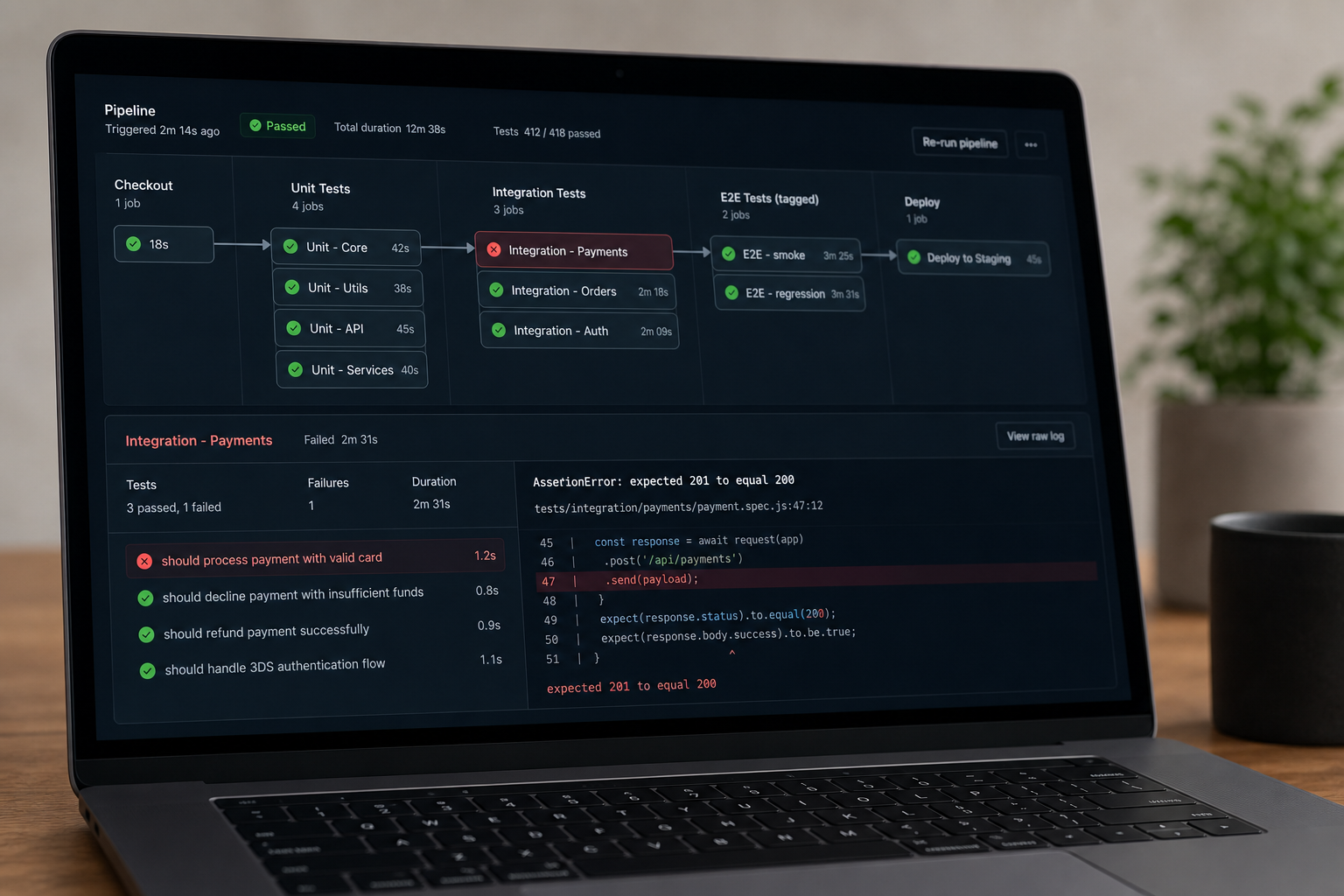
Flaky integration tests are not a test problem. They are an architecture signal wearing a test costume. The race condition that fails 1 in 50 runs in CI is the same race condition that will fail at 3 AM under production load. Suppressing flaky tests with retries does not solve the bug; it just delays the incident.
| Symptom | Likely Cause | How to Diagnose | First Fix to Try |
|---|---|---|---|
| Passes locally, fails in CI | DB version drift, missing env var, port collision | Diff local vs. CI environment | Containerize deps; pin DB version |
| Passes sometimes, fails randomly | Race condition, shared state, external jitter | Run failing test 100× in isolation | Transaction rollback; explicit polling; mock unstable externals |
| Fails only at scale or under load | Pool exhaustion, N+1 queries, missing index | Run with 10× normal volume; enable query logging | Add indexes; tune pool; refactor queries |
| Times out with no clear error | Deadlock, retry loop, hung downstream | Add structured logging at boundaries; cut timeout in half | Circuit breakers; cap retries; check circular calls |
| Setup takes 5+ minutes per run | Over-provisioned services, inefficient seeding | Profile setup phase; identify required services per test | Spin up only required containers; cache seed data |
| Tests pass but production breaks | Mocks diverged from real service behavior | Replay production traffic against suite | Replace top-traffic mocks with real or recorded responses |
Flakiness is usually an architecture signal, not a test problem. Tricentis and Testlio both treat flakiness as a symptom of real underlying issues — race conditions that exist in production, environments that drift from production, shared state that violates isolation. The instinct to mark a flaky test as retry: 3 and move on is the instinct that produces 3 AM pages six months later. Treat each flaky test as a small incident and you will catch the real incident before it ships.
The sleep(2) antipattern is the most common version of this mistake. A test fails because the message queue had not finished delivering when the assertion ran. A developer adds sleep(2). The test passes on the developer's laptop and fails in CI when CI is slower than the laptop. The fix is explicit polling: wait up to N seconds for a specific observable condition — the message arrived, the row exists, the status changed. Polling is both a debugging technique and a reliability technique. It tells you what the test is actually waiting for, which means it tells you what the system is actually doing.
Environment mismatch is the leading source of "works on my machine." Containerization with Testcontainers or Docker Compose for test dependencies removes nearly all of this failure class. Pin the database minor version. Pin the message broker version. Pin the language runtime. Silent drift in any of these three causes silent behavior changes — and the resulting flakiness costs more engineering hours than the containerization investment would have.
When mocks diverge from reality, contract tests close the gap. If your test suite is green but production keeps failing on integrations, your mocks are wrong — they encode an outdated or incorrect assumption about how the real service behaves. Consumer-driven contract tests run against the real provider validate the assumption your mock encodes, then fail loudly when the provider's behavior changes. This is the single highest-leverage investment for teams whose mocks have started to lie.
One operational note that gets skipped too often: integration test environments often contain production-shaped data, real secrets, and credentials with broad access. Test infrastructure is therefore a cybersecurity surface, not just an engineering convenience — leaked test environments have been the root cause of multiple high-profile breaches. Treat test database snapshots, mock auth tokens, and CI environment variables with the same controls you apply to staging. Rotate them. Scope them. Audit access to them. Test data that looks like production is production data for the purposes of any attacker who reaches it.
Integration Testing Readiness Audit — A 16-Point Self-Assessment
Walk through these 16 questions with your team this week. The questions you cannot answer "yes" to are your highest-leverage integration testing in software investments for the next quarter. This is a working diagnostic, not a recap.
Scope Definition (before writing one more test):
- Have you documented every third-party service your production system depends on, with its SLA and failure modes?
- Have you identified the top 3 integration points whose failure would cause customer-visible incidents?
- Does each owned integration have a versioned contract (OpenAPI spec, JSON Schema, or Avro definition)?
- Do you know which integrations are owned by you vs. owned by an external provider?
Test Coverage:
- Does every critical integration have at least one happy-path test crossing real boundaries (not all-mock)?
- Have you tested at least 5 failure scenarios per critical integration (timeout, malformed payload, 429, 5xx, auth expiry)?
- Do integration tests touch real databases and queues for components you own?
- Do you have contract tests for at least your highest-traffic service-to-service interfaces?
Test Reliability:
- Can your integration suite run 10 consecutive times with 100% pass rate?
- Are integration tests tagged and separated from unit tests in CI?
- Is every test's state isolated (transaction rollback, namespaced queues, dedicated ports)?
- Have you eliminated
sleep()calls in favor of explicit condition polling?
Operational Scale:
- Do new integration points get integration tests as a merge requirement, not a follow-up ticket?
- Is your CI environment containerized so DB and broker versions match production?
- Do you have a documented diagnostic playbook for the six flaky-test symptoms covered in the matrix above?
- Are integration test environments and their secrets treated with the same security controls as staging?
Score yourself honestly. Fewer than 8 yeses means integration testing is a reactive cost center for your team — you are paying for the tests but not getting the protection. 8 to 12 means you have a working foundation, but flakiness and environment drift are probably eating engineering hours every week that nobody is accounting for. For teams pushing into AI-driven features or robotics systems where integration failures cascade into physical or model-level consequences, 13 or more becomes the minimum bar — and the rare incidents that do slip through become precise signals you can act on, rather than mysteries that consume a whole sprint to triage.