
VoxelioOn-device 3D capture and reconstruction
Spatial computing · Live on the App Store
Overview
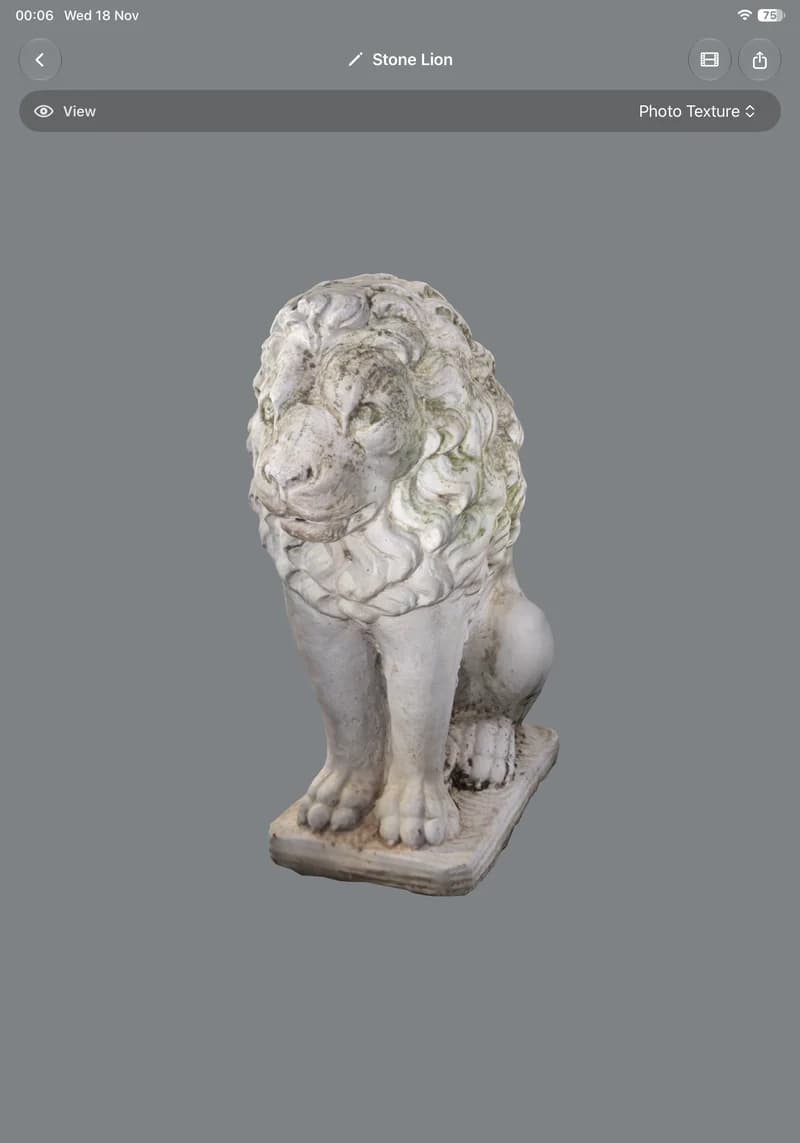
Voxelio gives designers and 3D creators a mobile workflow for capturing objects and rooms. The app can build visual 3D results from camera views and capture measured geometry on supported LiDAR devices. Users can review a scan, add views, and export either a result or its calibrated source data.
My role
I built the native capture and review workflows and integrated on-device training, Metal rendering, and dataset export.
Architecture & implementation
Capture calibrated observations
ARKit supplies camera poses and intrinsics. A session records images with that calibration and preserves measured depth and confidence when the active capture path provides them. RoomPlan supplies a separate structured room representation on supported devices.
Train and render locally
The capture workspace assembles the source dataset and calls msplat for on-device Gaussian training. MetalSplatter renders the result in the app for interactive review.
Keep the source and result linked
Each training run binds to a source revision. Adding views produces a new revision and preserves the prior valid result until a replacement succeeds. Users can export a trained splat or take the original calibrated observations to a desktop pipeline.
Engineering challenges & trade-offs
On-device processing gives users a complete local workflow, but scene size and quality must fit mobile memory and thermal limits. Camera-only captures broaden hardware support and carry different evidence from measured LiDAR geometry, so the app preserves the capture type through processing and export.
Results
Voxelio 2.0 shipped camera-only visual 3D capture, calibrated desktop dataset export, and the ability to add views while preserving earlier revisions. The App Store listing and public Gaussian splatting demo give two ways to inspect the work.